université de lille, september 2024
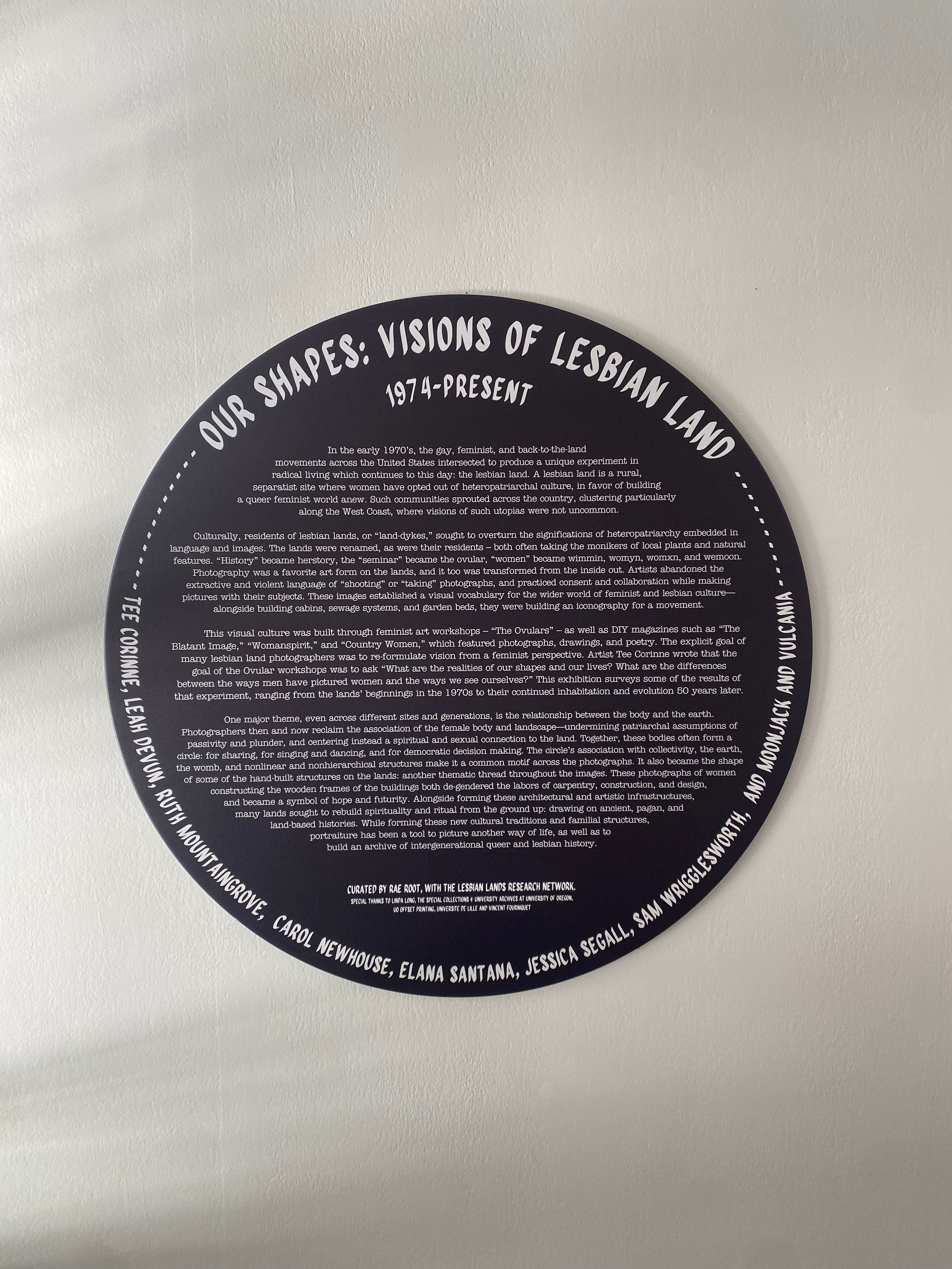
In the early 1970’s, the gay, feminist, and back-to-the-land movements across the United States intersected to produce a unique experiment in radical living which continues to this day: the lesbian land. A lesbian land is a rural, separatist site where women have opted out of heteropatriarchal culture, in favor of building a queer feminist world anew. Such communities sprouted across the country, clustering particularly along the West Coast, where visions of such utopias were not uncommon.
Culturally, residents of lesbian lands, or “land-dykes,” sought to overturn the significations of heteropatriarchy embedded in language and images. The lands were renamed, as were their residents – both often taking the monikers of local plants and natural features. “History” became herstory, the “seminar” became the ovular, “women” became wimmin, womyn, womxn, and wemoon. Photography was a favorite art form on the lands, and it too was transformed from the inside out. Artists abandoned the extractive and violent language of “shooting” or “taking” photographs, and practiced consent and collaboration while making pictures with their subjects. These images established a visual vocabulary for the wider world of feminist and lesbian culture—alongside building cabins, sewage systems, and garden beds, they were building an iconography for a movement.
This visual culture was built through feminist art workshops – “The Ovulars” – as well as DIY magazines such as “The Blatant Image,” “Womanspirit,” and “Country Women,” which featured photographs, drawings, and poetry. The explicit goal of many lesbian land photographers was to re-formulate vision from a feminist perspective. Artist Tee Corinne wrote that the goal of the Ovular workshops was to ask “What are the realities of our shapes and our lives? What are the differences between the ways men have pictured women and the ways we see ourselves?” This exhibition surveys some of the results of that experiment, ranging from the lands’ beginnings in the 1970s to their continued inhabitation and evolution 50 years later.
One major theme, even across different sites and generations, is the relationship between the body and the earth. Photographers then and now reclaim the association of the female body and landscape—undermining patriarchal assumptions of passivity and plunder, and centering instead a spiritual and sexual connection to the land. Together, these bodies often form a circle: for sharing, for singing and dancing, and for democratic decision making. The circle’s association with collectivity, the earth, the womb, and nonlinear and nonhierarchical structures make it a common motif across the photographs. It also became the shape of some of the hand-built structures on the lands: another thematic thread throughout the images. These photographs of women constructing the wooden frames of the buildings both de-gendered the labors of carpentry, construction, and design, and became a symbol of hope and futurity. Alongside forming these architectural and artistic infrastructures, many lands sought to rebuild spirituality and ritual from the ground up: drawing on ancient, pagan, and land-based histories. While forming these new cultural traditions and familial structures, portraiture has been a tool to picture another way of life, as well as to build an archive of intergenerational queer and lesbian history.
-
Curated by Rae Root, with the Lesbian Lands Research Network